Sunday, April 28, 2019

Week 4 - MedTech and Art

This week we learned about the relationship between Medical Technology through the years and it's meaning with art. Back in the time of the Hippocratic Oath, doctors viewed science and art as the same exact practice. They thought that a doctor working on a patient and doing their work on the patient was the same thing as an artist working on a piece of paper and doing their work on the paper.

Many people of that time had the belief that working with the human body in a medical field was a form of art. I can see why this is plausible because myself, I personally agree with this belief, because in a way they are either fixing, or adding to the human body. For doctors, the human body was their canvas, just as artists have paper as their canvas, both require a canvas to complete their work. Therefore, both artists and doctors while the work they complete is far from similar, they are both using their forms of work, and in their own way, making artwork.
https://www.ancientpages.com/2015/10/07/hippocrates-didnt-write-oath-father-medicine/
The unfortunate issue however, is that doctors today no longer believe in the Hippocratic Oath, and now see their field of work less artistic and more of a science. I think that their old belief was more accurate due to the doctors having their canvas being a human body. When a doctor operates on a human body, the body becomes the object that the doctor is working on. Whether the doctor is performing surgery, cutting off a limb or simply prescribing medical drugs to help the person, the doctors work is the human body that's being worked on. Therefore, In my eyes, any profession completing their work, is their form of art.
http://health.sunnybrook.ca/wp-content/uploads/2014/05/yhm-cancer-nutrition-1-425x282.jpg
Another way that Art Medical Technology are related is by the Medical Technology itself producing forms of artwork like a painting does. As argued by Silvia Casini, "the MRI has a 'look' in the same way that the portrait has". I found her argument quite intriguing because after thinking about it, I completely agreed with her. An MRI scan allows a person to see the muscular structure of a person's body. The MRI scanner produces an image of the person's body and it appears quite artistic. Many artists produced paintings of human muscular structures from the motivation from the Medical Technology scanners used by doctors.
https://humananatomyandstructureoflivingthings.wordpress.com/desktop-wallpapers/

“CTheory.net.” CTheory.net. N.p., n.d. Web. 25 Oct. 2012. <http://www.ctheory.net/articles.aspx?id=71>.


ELITEIMAGING. “Understanding MRIs.” YouTube. YouTube, 15 Dec. 2008. Web. 25 Oct. 2012. <http://www.youtube.com/watch?v=H5q79R9C-mk>.


Tyson, Peter. “The Hippocratic Oath Today.” PBS. PBS, 27 Mar. 2001. Web. 25 Oct. 2012. <http://www.pbs.org/wgbh/nova/body/hippocratic-oath-today.html>.


“Usability of Electronic Medical Records.” - International Journal of Usability Studies. N.p., n.d. Web. 25 Oct. 2012. <http://www.upassoc.org/upa_publications/jus/2009february/smelcer5.html>.


Vesna, Victoria. “Medicine and Art: Part 2.” YouTube. YouTube, n.d. Web. 25 Oct. 2012. <http://www.youtube.com/watch?feature=player_embedded>.

Wednesday, April 24, 2019

Event 1 - UCLA Meteorite Gallery

This week, I visited the UCLA Meteorite gallery museum and had a look at several types of meteorites. I learned lots of information I had no clue about before about meteorites. Like meteorites are just streaks of light and not actually a "shooting star". They are piles of rock and metal entering our atmosphere at a very fast speed, which causes the burning look to form around it. An interesting fact is  meteoroid is when the pile of rock or iron is floating in space, while a meteor is when the pile of rock and iron falls into the Earth's atmosphere, and only once the meteor hits the Earth is when it becomes a meteorite. Pictured below is a photograph of myself and a student facilitator who works at the meteorite gallery.
One way that the UCLA Meteorite gallery is related to this courses information is through the two cultures we learned during week one. The two cultures and the Meteorite Gallery work hand in hand. The meteorite is examined thoroughly with science to discover what its composed of, where it came from, and in attempt to determine if there are more to come. Once, thoroughly examined with science, the meteorite is displayed on a showcase for art. It is designed for a visual appeal to people visiting the meteorite gallery. Thus, both science and art working hand in hand at the UCLA Meteorite Gallery.
In my opinion, I found the Meteorite Gallery to be very helpful and an overall fun experience. I learned things I never even thought of before about meteorites and how a meteorite is formed what a meteorite is. I personally would recommend visiting the UCLA Meteorite gallery for not only learning new facts about meteorites, but the gallery also includes an aspect of art as well, which has helped me to understand the material so far throughout the course, and it might just help you as well.

Sunday, April 21, 2019

Week 3 - Robotics and Art

This week, we studied the implications of robotics in the film industry. Obviously, like all things, technology and robotics have immensely improved over the years. Likewise, the start of robotics in the film industry are nowhere near as complex, or convincing than it is today. I remember the first movie I ever watched with the implementation of robotics. The movie was Jaws. I remember I was too scared to go swimming in any body of water after watching the movie because of how real the mechanical shark appeared before my eyes. Today, the movie The Meg is not even comparable to Jaws due to the advanced improvement in technology and robotics in the film industry.

Because of the lack of knowledge about robotics and technology back when Jaws was made, the mechanical shark would not stop breaking down, and struggled to keep working the way it was designed. However, Spielberg managed to implement this malfunction into the movie and improve it by showing the shark less than what was wanted. In fact, due to this decision, the movie was arguable better. As said by Spielberg himself, "I think the film would have made half the money had the shark worked".
https://sarahsonjawsvlog.files.wordpress.com/2015/02/jaws3.jpg
Some artists, on the other hand use robotics to create their own pieces of artwork. Most of these pieces are sculptures. One example of an artists implementing robotics to improve his artwork is Spencer Shay in the TV series iCarly. He made all sorts of funky sculptures but in one episode, spencer tries to break the Guinness book of records of most moving parts on an art sculpture at once, which was 73. Spencer breaks the record and every part on his sculpture movies in a certain direction, whether it be up or down, side to side or swinging around in circles. Each part on his sculpture is a robotic element added to art to complete a piece of art.
Overall, this week I took away that robotics in art is a never-ending improvement and innovation. The immense improvements made so far in the film industry with the addition of robotics has taken movies to another level. Whether it be with mechanical sharks, green screens, or shaping the bodies and faces of characters with body suits matching the green screens, technology is allowing for improvements in the robotics and film industry, and begs the question, What will come next? Is there going to be movie theatres with rocking seats and virtual reality goggles that allow for yourself to feel like you're literally in the movie? or maybe movies that allow you to control the plot and decide what happens with your remote? Or maybe even actual robots in movies? Only the future innovations with robotics and film will tell.
https://cdn.pastemagazine.com/www/articles/C3PO-R2D2-header.jpg

Arduino, www.arduino.cc/. Accessed 15 Apr. 2019.


Benjamin, Walter. The Work of Art in the Age of Mechanical Reproduction. 1936.


“Gijs Van Bon.” Gijs Van Bon, www.gijsvanbon.nl/.


Hong, Dennis. “Transcript of ‘My Seven Species of Robot -- and How We Created Them.’” TED, Sept. 2009, www.ted.com/talks/dennis_hong_my_seven_species_of_robot/transcript.


Wieringa, Freerk. “Exoskeleton.” Freerk Wieringa, www.freerkwieringa.nl/.

Sunday, April 14, 2019

Week 2 - Mathematics and Art

When people examine a work of art, most of them just observe the pretty colors and the large shapes that create the design the artist was going for. But there are other aspects of artwork that people don't tend to see. That is the artists implementation of the fourth dimension. An article focused on the fourth dimension and its implementation in modern art written by Linda Dalrymple Henderson explains this different style aspect of painting that began in the early 1920's.

The very few artists at the time that took interest in the fourth dimension in art were such famous painters as Duchamp, Picabia and Kupka. Most of these artists paintings consisted of creating the same large figure in their painting, but the large figure was created with a large amount of smaller geometric shapes. This painting by Picabia demonstrates this technique by creating a large mountain with a bunch of smaller geometric shapes.
Picabia Painting 4D

Artists since the beginning of the fourth dimension implementation have been fascinated by adding shapes into their pieces of artwork. In the words of a cubist artist, "...We are motivated by a desire to complete our subjective experience by inventing new aesthetic and conceptual capabilities" (Henderson). Mathematics in art is in no way to solve math equations or find a different solution for the meaning of a painting, but solely to express and allow new ways of perceiving and visually seeing a piece of artwork. The most common form of math implemented in artwork is geometrics and all sorts random shapes to help construct a piece of artwork.

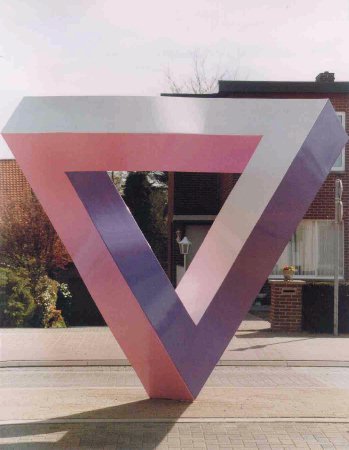
The same situation can be said for sculptors. Where the implementation of arithmetic's in sculptures allows for a very unique and almost impossible, mind blowing look to the sculpture. Some of these shapes include cubes, triangles. One sculptor said "The more symmetric design added to a sculpture, the more elegant and cleansing is its shape, getting it closer of the elemental geometric solids like the cube, the tetrahedron, octahedron, the dodecahedron or the icosahedron"(Seven). An example of one of these impossible looking shape sculptures is the impossible triangle sculpture.
https://im-possible.info/images/art/sculpture/hemaekers/unity.jpg

Abbott, Edwin A. “Flatland By Edwin A. Abbott – PDF Download.” Free EBooks and AudioBooks, 17 Dec. 2010, egoarchive.com/book/410943153/flatland. 

“Bathsheba Grossman.” Wikipedia, Wikimedia Foundation, 21 Dec. 2018, en.wikipedia.org/wiki/Bathsheba_Grossman.

“Sculpture and Math.” OBVIOUS, obviousmag.org/en/archives/2010/06/sculpture_and_math.html.

“Understanding the Fourth Dimension From Our 3D Perspective.” Interesting Engineering, 12 Mar. 2018, interestingengineering.com/understanding-fourth-dimension-3d-perspective. 

“Victoria Vesna | University of California, Los Angeles.” Academia.edu, ucla.academia.edu/VVesna.

Sunday, April 7, 2019

Week 1 - Two Cultures

The connection between the two cultures of art and science was explained thoroughly in the words of Charles Snow. During a lecture in 1959 at Cambridge university, Snow explained the two cultures as separated by literary intellectuals and natural science. Later on, there was an article written from Snow's lecture that helped show his personal experiences and relationship with these two cultures.

In today's world there are two types of people. Those who think believing is seeing, and those who think that seeing is believing. Scientists tend to study and look at things that are less curious and plausible. While artists tend to look beyond what is already known and are far more optimistic than scientists. Artists also tend to be more creative and open-minded than scientists.

Going along with artists being more creative than scientists, I see the difference between the two cultures every day here at UCLA. Walking to and from class, or practice the difference is evident in the way they express themselves through their attire. While some stereotypes fall under their attire, like scientists usually wearing glasses and bland normal clothing, they also tend to have larger backpacks than artists. Most artists on campus tend to have smaller backpacks, more expensive like Gucci, or Jansport backpacks, which are typically more colorful and expressive of themselves.
After examining both of these cultures, my thinking has changed. I thought nobody was the same and everybody on earth has a different mind and viewpoint. But, it has now changed to seeing that both groups are equally intelligent and only different in their outputs and thoughts on life. Both groups while both study generally the same topics, break off into specific pieces of those topics, some just more creative than others.


Wilson, Stephen D. “Myths and Confusions in Thinking about Art/Science/Technology.” College Art Association Meetings. New York, New York, 2000. Print

Snow, C. P. The Two Cultures and the Scientific Revolution. New York: Cambridge UP, 1959. Print.


Vesna, Victoria. "Toward a Third Culture: Being In Between." Leonardo. 34 (2001): 121-125. Print.
Kelly, Kevin. "The Third Culture." The Third Culture. N.p., n.d. Web. Feb. 1998
Bohm, D. "On Creativity." JSTOR. N.p., n.d. Web. 04 Oct. 2013.


Event 3

This past weekend I visited the Noise Aquarium at UCLA University. In my opinion, I found this aquarium rather confusing but non the less st...