The very few artists at the time that took interest in the fourth dimension in art were such famous painters as Duchamp, Picabia and Kupka. Most of these artists paintings consisted of creating the same large figure in their painting, but the large figure was created with a large amount of smaller geometric shapes. This painting by Picabia demonstrates this technique by creating a large mountain with a bunch of smaller geometric shapes.
 |
| Picabia Painting 4D |
Artists since the beginning of the fourth dimension implementation have been fascinated by adding shapes into their pieces of artwork. In the words of a cubist artist, "...We are motivated by a desire to complete our subjective experience by inventing new aesthetic and conceptual capabilities" (Henderson). Mathematics in art is in no way to solve math equations or find a different solution for the meaning of a painting, but solely to express and allow new ways of perceiving and visually seeing a piece of artwork. The most common form of math implemented in artwork is geometrics and all sorts random shapes to help construct a piece of artwork.
 |
|
|
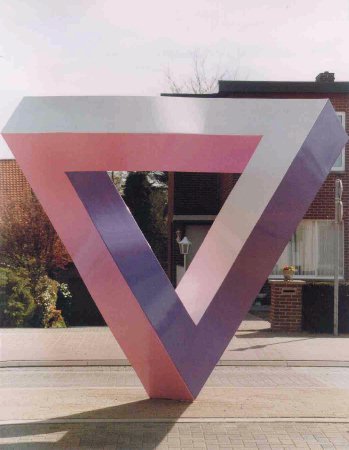
The same situation can be said for sculptors. Where the implementation of arithmetic's in sculptures allows for a very unique and almost impossible, mind blowing look to the sculpture. Some of these shapes include cubes, triangles. One sculptor said "The more symmetric design added to a sculpture, the more elegant and cleansing is its shape, getting it closer of the elemental geometric solids like the cube, the tetrahedron, octahedron, the dodecahedron or the icosahedron"(Seven). An example of one of these impossible looking shape sculptures is the impossible triangle sculpture.
 |
| https://im-possible.info/images/art/sculpture/hemaekers/unity.jpg |
Abbott, Edwin A. “Flatland By Edwin A. Abbott – PDF Download.” Free EBooks and AudioBooks, 17 Dec. 2010, egoarchive.com/book/410943153/flatland.
“Bathsheba Grossman.” Wikipedia, Wikimedia Foundation, 21 Dec. 2018, en.wikipedia.org/wiki/Bathsheba_Grossman.
“Sculpture and Math.” OBVIOUS, obviousmag.org/en/archives/2010/06/sculpture_and_math.html.
“Understanding the Fourth Dimension From Our 3D Perspective.” Interesting Engineering, 12 Mar. 2018, interestingengineering.com/understanding-fourth-dimension-3d-perspective.
“Victoria Vesna | University of California, Los Angeles.” Academia.edu, ucla.academia.edu/VVesna.


Great job of tying key components of this week lectures and common knowledge. Also great job of quoting the readings.
ReplyDelete